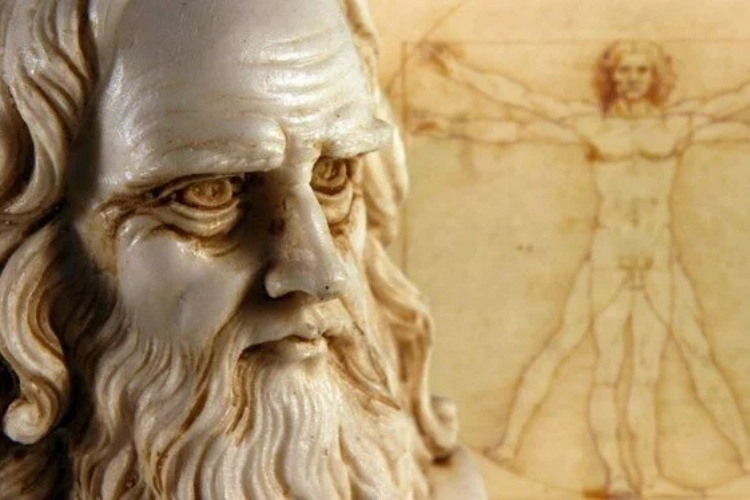
The hidden geometric ratio in Leonardo da Vinci’s famous Vitruvian Man drawing, which left its mark on history, has finally been deciphered.
Drawn 500 years ago by the Renaissance artist Leonardo da Vinci, the Vitruvian Man, believed to depict a “perfectly proportioned male body,” is considered one of the most famous drawings combining art, mathematics, and anatomical knowledge.
Dr. Rory Mac Sweeney, a dentist based in London, claims to have cracked the geometric code behind this drawing.
According to Sweeney, the hidden key in the drawing lies in the “equilateral triangle” mentioned in da Vinci’s notes and placed between the figure’s legs.
THE “BONWILL TRIANGLE” CONNECTION
Dr. Sweeney suggests that this triangle is not a random shape and reflects a frequently repeated design plan in nature.
The doctor noted that the triangle coincides with an anatomical structure known as the “Bonwill Triangle,” which governs jaw function in dentistry.
The use of this triangle in the drawing also reveals the ratio between a square and a circle: 1.64. This ratio is extremely close to 1.6333, a special number that repeats in nature and forms the basis of “efficient structures.”
“THE SAME PLAN USED AS THE UNIVERSE”
Sweeney stated that this ratio is found not only in the human body but also in the atomic structure of strong crystals, the proportions of the human skull, and the tightest packing of spheres.
Emphasizing that the same ratio has been captured, Sweeney said, “Leonardo sensed that our bodies are constructed with the same mathematical elegance as the universe.”
VITRUVIUS MAN
According to the new findings, Vitruvian Man is considered not only an aesthetic masterpiece but also a scientific hypothesis far ahead of its time. The study was published in the academic journal Journal of Mathematics and the Arts.
The conclusion of the article states, “Leonardo da Vinci’s clear reference to the equilateral triangle between the figure’s legs shows how the drawing was constructed and reveals the anatomical basis for his choices of proportions.”