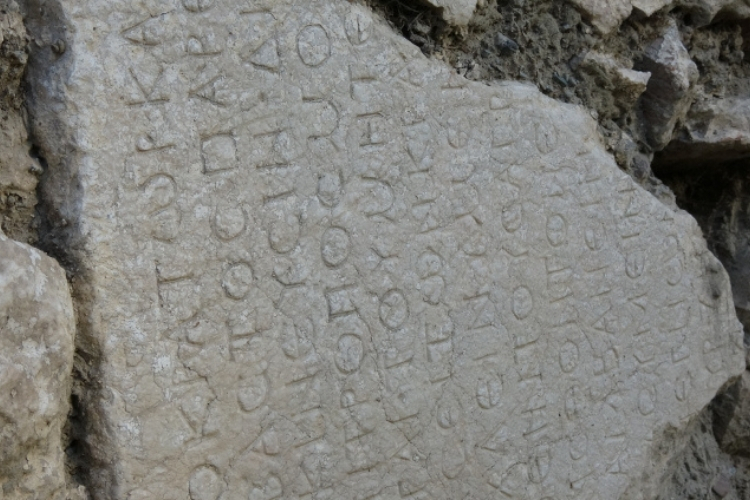
It was revealed that the stones used in the exterior walls of a house built in the 1950s in the Yeşilova district were actually a letter belonging to Roman Emperor Caracalla, who lived between 186 and 217 AD.
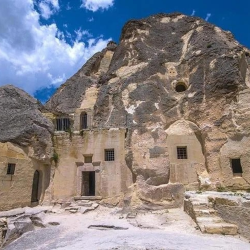
In the 1950s, villagers took stones from an area close to the ancient city of Takina, located near Yarışlı Village in Burdur’s Yeşilova district, to build houses.
The villagers transported these stones to the village by horse-drawn carts, given the conditions of the time, and used them in house construction.
In 1970, archaeologists conducting research in the region determined that these stones were part of a letter written by Roman Emperor Caracalla, who lived between 186 and 217 AD. Ten stones used in the foundation of the house were documented and placed under monitoring by the Burdur Museum Directorate.
Following a written notice sent by the Directorate to the village headman and the homeowners, it was announced that a demolition decision had been made for the house and that the stones would be removed and preserved by the Directorate.
Today, although no one lives in the house, the stones bearing the letter of Roman Emperor Caracalla continue to stand, defying time.
“I have never seen such stones anywhere else”
Ferhat Ağıl (65), who stated that the house was built by his father-in-law, said:
“My wife and I got married in 1988. This house belonged to my father-in-law. He gave it to my wife, and after she passed away, it was inherited by my daughter. My brothers-in-law brought these stones. We call the place they brought them from Asar Hill. They brought them from there and built this house. About 22 years ago, a letter came from the museum. That letter is still kept at the village headman’s office. We were told that if the house was demolished, we must not lose the stones, and that these stones were entrusted to us. At the time, archaeologists even came from Istanbul and carried out studies here. They told me that these stones belonged to the Roman period. They were living in this house during the 1971 earthquake. Back then, the stones were brought by horse-drawn carts. Only 5 or 6 people had tractors at that time. The stones were broken into pieces. They placed the inscribed sides facing the road. Later, they realized the situation because of the inscriptions. I have never seen such stones anywhere else.”